
Improving Zoning Together: Strong Business Corridors Outcome

By: Daniel Cooper
May 29, 2025 / Blogs
May 29, 2025 / Blogs
Improving Zoning Together: How do zoning and land use affect economic outcomes in commercial and business corridors?
Metropolitan Planning Council (MPC) and the Urban Institute are conducting research on how zoning and land use impact Chicago’s neighborhoods and residents from an equity, sustainability, and public health perspective. We are assessing and quantifying the extent to which zoning and changes in zoning have contributed to Chicago’s long-standing inequities across seven priority outcomes: affordable housing, strong business corridors, limited pollution exposure, accessible public transit hubs, productive land use, available groceries and healthcare, and mitigation and adaptation to climate change.
This work on commercial and business corridors is part of a larger blog series titled ‘Improving Zoning Together‘, which explores our research findings based on each of the research outcomes.

In this blog, we provide a succinct summary of our research into 1) how business outcomes are distributed across the City of Chicago, 2) how business and commercial zoning, as well as land use, differs across Chicago, 3) and how zoning and business outcomes are related across Chicago neighborhoods.
How are business and business-related outcomes distributed across the City of Chicago?
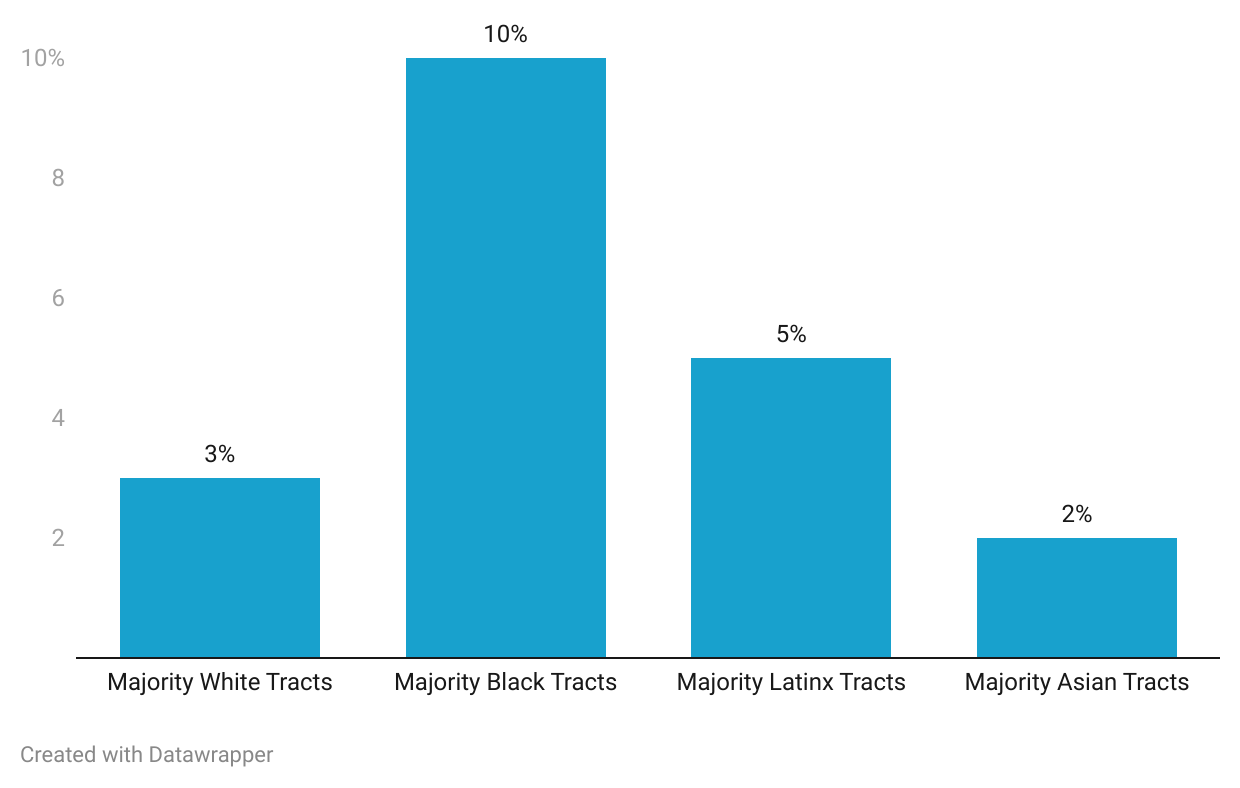
Businesses in the City of Chicago are more highly concentrated in census tracts with higher shares of white population and lower shares of Black population, reflecting yet another inequity related to the city’s longstanding segregation. In majority-white census tracts, for example, there were an average of 14.7 businesses per 1,000 residents in 2023, compared with 8.6 businesses per 1,000 residents in majority-Black census tracts (Figure 1). Vacancy rates, another key indicator of economic vitality, show similar disparities across racial and ethnic groups, with majority-Black tracts possessing vacancy rates over three times greater than majority-white and five times greater than majority-Asian census tracts during the same timeframe (Figure 2).
In Chicago’s business and commercial corridors (which, for the sake of simplicity, we define as Special Service Areas), the economic picture differs depending on the market profile. Lower income corridors have a higher percentage of small business jobs and have witnessed job losses over the past two decades, highlighting the precarious position of both the corridors and the small businesses within them. Conversely, the highest-income business and commercial corridors, primarily located on the city’s North Side, have seen higher job growth and larger sized businesses.
Figure 1
Average businesses per 1000 residents
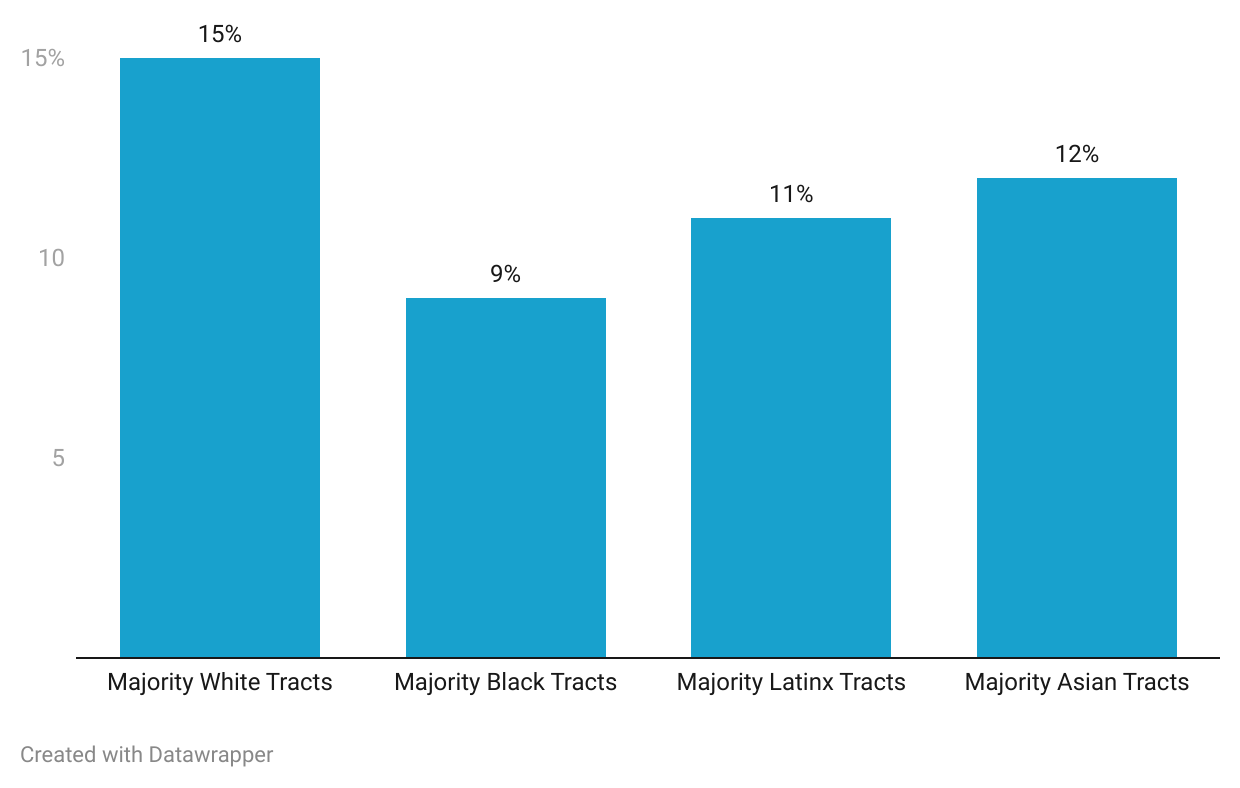
Figure 2
Vacant property rates double citywide average in majority Black areas
What does business and commercial zoning—and corresponding land use—look like in Chicago?
Approximately 9% of City of Chicago land is zoned, by-right, for commercial and business use. Although zoning for commercial and business use can be found everywhere in the city, there are higher shares in downtown and Northside neighborhoods (Figure 3). In addition, Chicago’s pedestrian street designations—business corridors that have guidelines that promote a “Main Street” pedestrian shopping experience—are very heavily concentrated on the North Side (Figure 4).
Figure 3
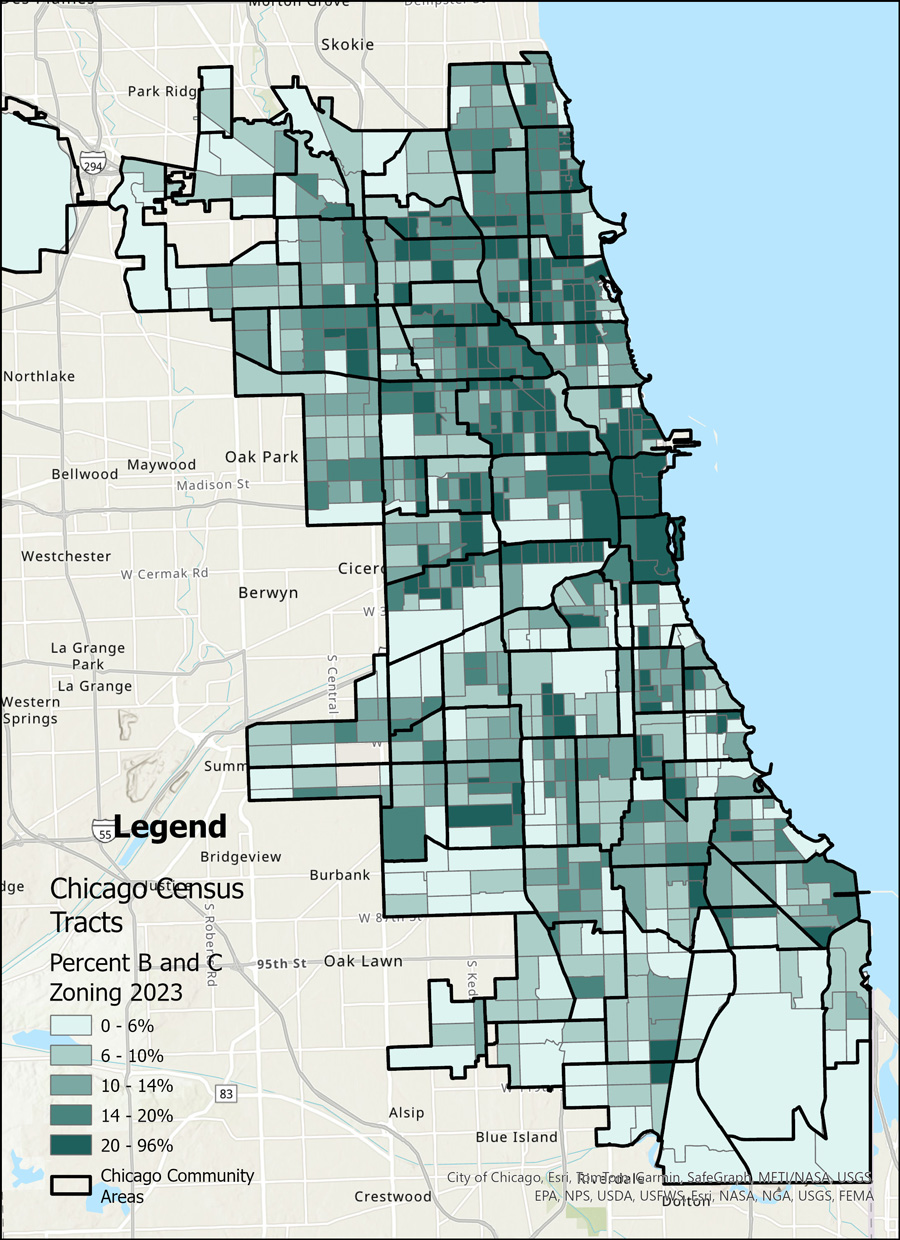
Figure 4

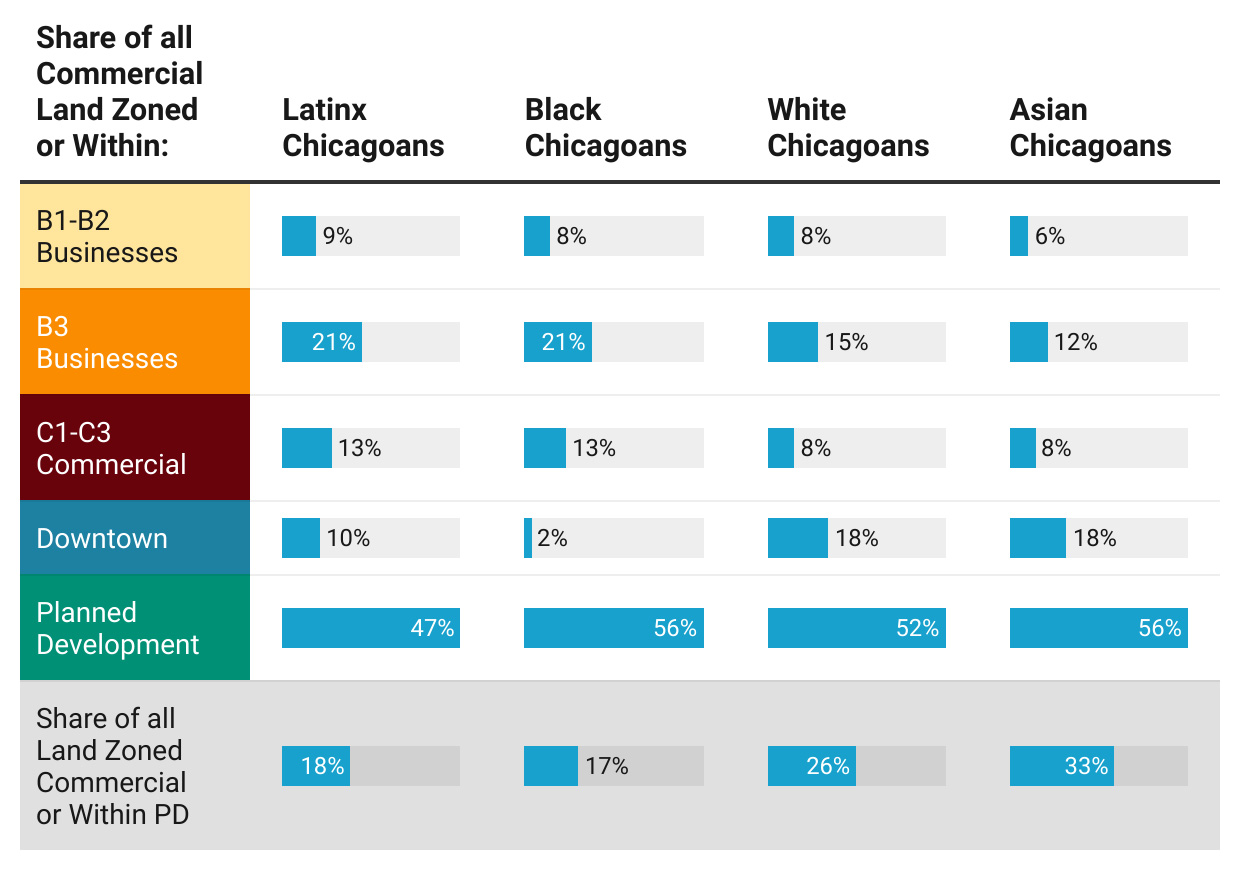
Ultimately, there are tangible differences in how different racial and ethnic groups in Chicago experience business-related land use and zoning in their neighborhoods. Black and Latinx Chicagoans are more likely than White and Asian Chicagoans to live near B3 and C zoning types, which are associated with uses that encourage automobile use (e.g. offices and businesses with parking lots) as opposed to mixed-uses with ground-floor retail (Figure 5). The more automobile-oriented zoning categories of B3 and C zoning do contain a higher percentage of businesses, jobs, and consumer spending than B1 and B2 zoning (i.e. ground-floor retail), but could come at the expense of the pedestrian shopping experience and business corridor vibrancy.
Figure 5
Created with Datawrapper
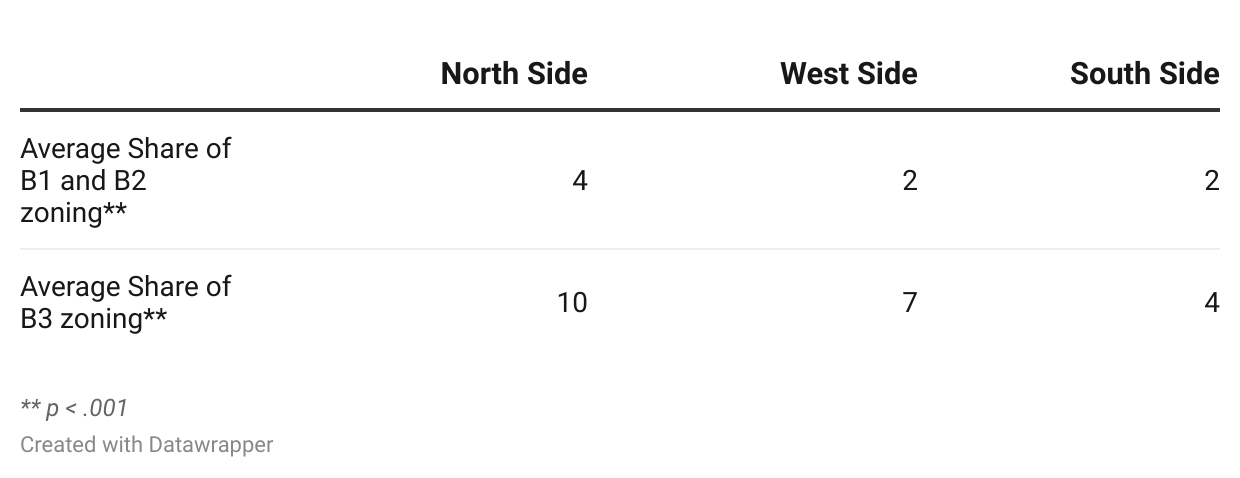
There are also significant differences between North Side and South and West Side areas in terms of the share of all B zoning within a half mile of CTA stops (Figure 6). North side areas that are served by transit have greater shares of B zoning than the rest of the city, giving them an advantage in terms of business corridor vibrancy. In sum, our work demonstrates that North Side neighborhoods have zoning and land use policies that allow business corridors to thrive as walkable districts when compared to other areas of the city.
Figure 6
What do zoning trends mean for Chicago’s business corridors?
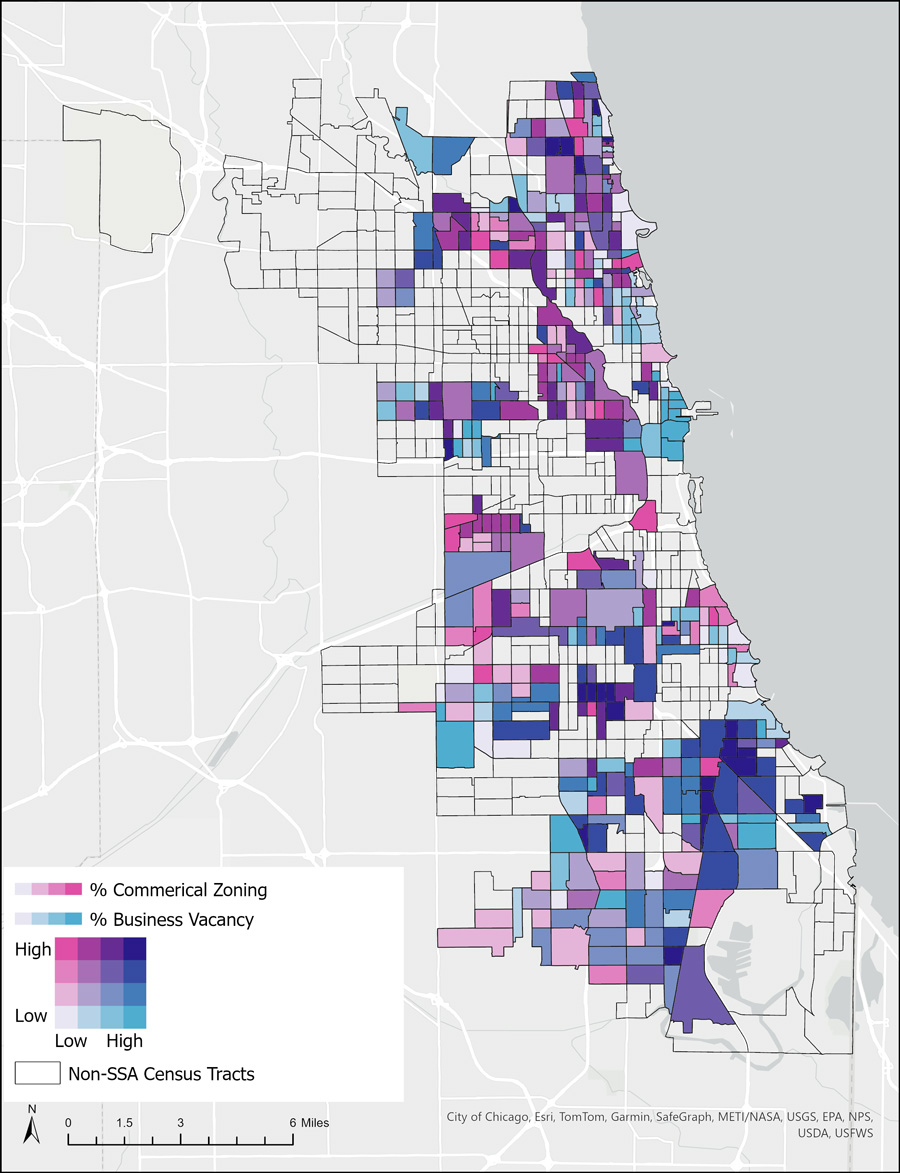
To date, our research suggests that by-right business and commercial zoning changes over the last two decades are ultimately a reflection of market activity. Areas that witnessed any changes in business and commercial zoning over the past decade, whether increases or decreases, ultimately saw more positive economic changes between 2003 and 2023 (Figure 7). For example, home value changes and consumer spending were greater in areas that saw any B and C zoning changes than areas that saw no change. Zoning changes accompany development changes and market activity, and therefore simply reflect active markets. We don’t have any evidence that zoning changes drive market activity. However, this does not mean there isn’t room for strategic changes related to zoning and accompanying land use policies and practices. Our research also indicates there is a small but significant correlation (r = .074, p < .05) between the share of C zoning in census tracts and business vacancy rates in 2022 (Figure 8). This is just one area where proactive zoning changes could have an impact in encouraging more mixed-uses and lowering barriers for new businesses.
Figure 7
Distinct demographic changes, stronger market indicators where zoning changes occurring
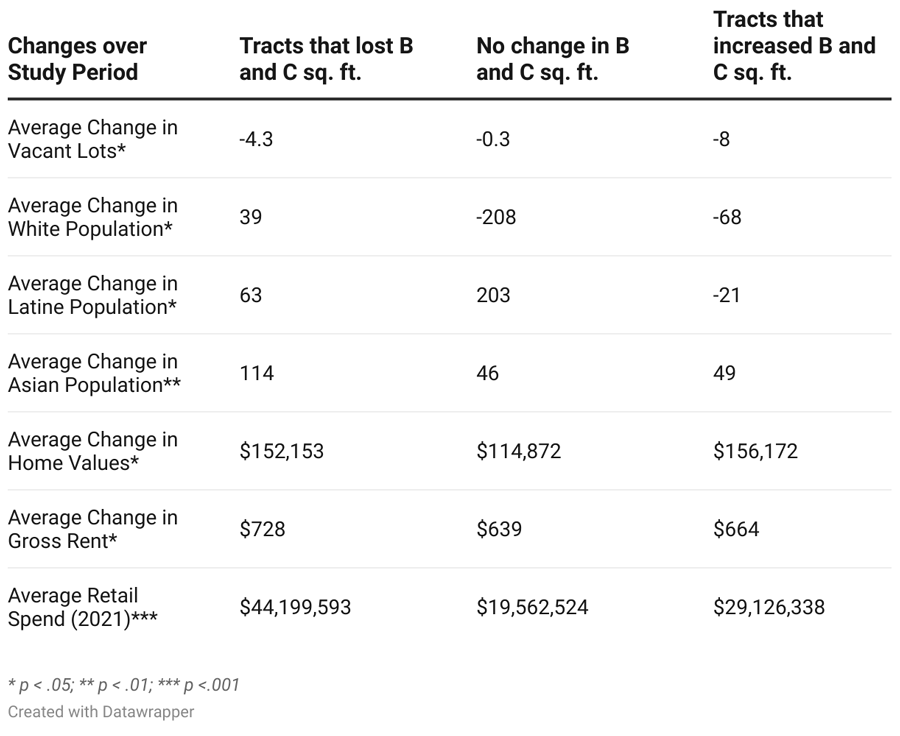
Figure 8
Key Takeaways
Business and commercial activity is inequitably distributed across Chicago. Although zoning is perhaps not largely responsible, changes to zoning policies could nonetheless play an important role in enhancing business corridor vibrancy in all neighborhoods. As MPC and its collaborators continue to assess the many impacts of zoning in Chicago, we are exploring policy recommendations that could mechanism to proactively realign the zoning code in ways that respond to conditions such as vacancy. Future iterations of this work will include in-depth recommendations that can help reduce disparities in how Chicagoans experience business and commercial vibrancy across Chicago neighborhoods.
Related Reading
Blog Series: Improving Zoning Together
- Improving Zoning Together: Introductory Blog
- Limited Pollution Exposure Outcome (Part 1 of 2)
- Limited Pollution Exposure Outcome (Part 2 of 2)
- Affordable Housing Outcome (Part 1 of 2)
- Affordable Housing Outcome (Part 2 of 2)
- Strong Business Corridors Outcome
- Accessible Public Transit Hubs Outcome
- Available Groceries and Healthcare Outcome
- Mitigation and Adaptation to Climate Change Outcome