
Zoning & Land Use Assessment Research Findings

Metropolitan Planning Council (MPC) and the Urban Institute are working in partnership with local stakeholders to assess the impacts of zoning and land use on public health, equity, and sustainability, and to develop recommendations for better planning and development practices. The key guiding questions for this project are:
- What are the public health, equity, and environmental impacts produced by Chicago’s zoning and related land use practices?
- How do outcomes differ by neighborhood?
- What changes could be implemented to improve sustainability, racial, and health equity?
To answer these guiding questions, stakeholders from the project’s Steering Committee used definitions for equity, sustainability, and public health to develop a list of built environment outcomes that they would like to see in Chicago. These outcomes were prioritized into seven key topics, and they form the basis of the research. Here is the list of outcomes we are analyzing:

We took a three-part approach to the research.

First, we focused on understanding the outcome we were reviewing. Second, we focused on understanding how zoning intersected with the outcome. Third, we focused on connecting the outcome with the zoning to understand the relationship between the two. To review zoning, maps and data sets were compiled to compare changes across three distinct points in time: 2003, 2013, and 2023.
Affordable Housing

Metrics
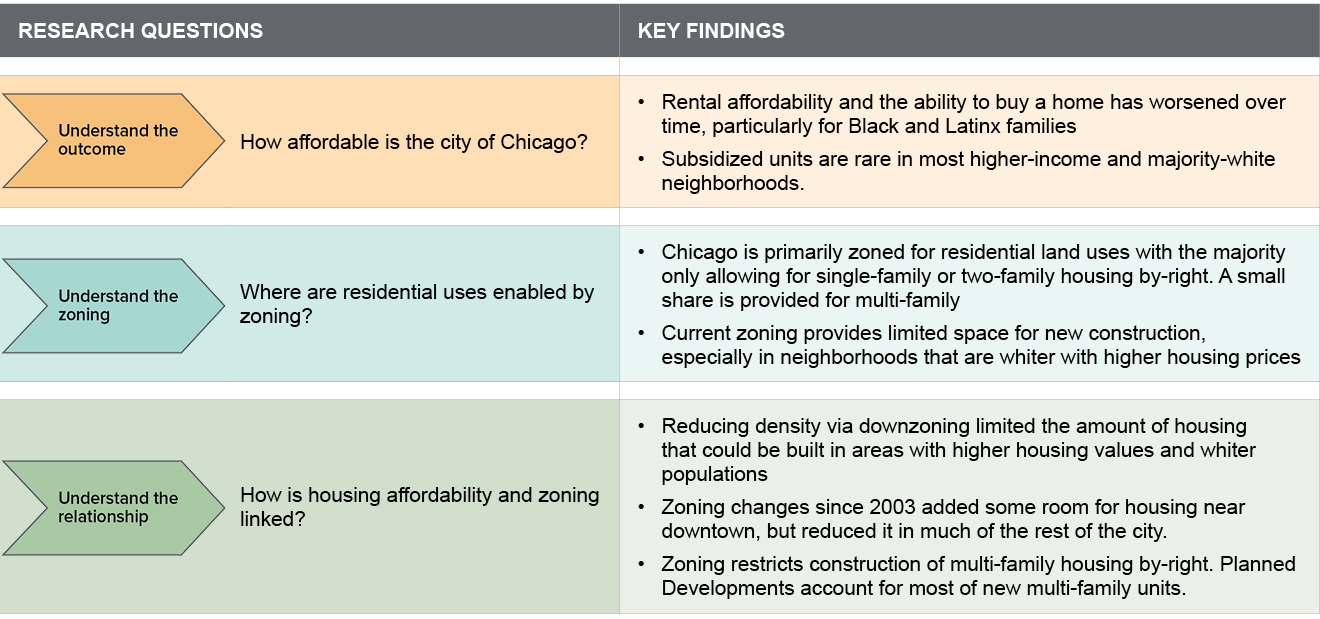
To analyze affordability, the research team used Census data on metrics like rental prices, home values, demographics, and data on subsidized housing units. Permitting data was analyzed from the City of Chicago.
Affordable Housing: Research Questions & Key Findings
Read more
- Blog Series: Improving Zoning Together: Affordable Housing Outcome (Part 1 of 2)
- Blog Series: Improving Zoning Together: Affordable Housing Outcome (Part 2 of 2)
Strong Business Corridors

Metrics
Five measures of business vibrancy were analyzed in relation to zoning: business density, business vacancy, consumer spending, employment density, and employment diversity. Business corridors and pedestrian corridors were also defined and reviewed.
Strong Business Corridors: Research Questions & Key Findings

Read more
Limited Pollution Exposure

Metrics
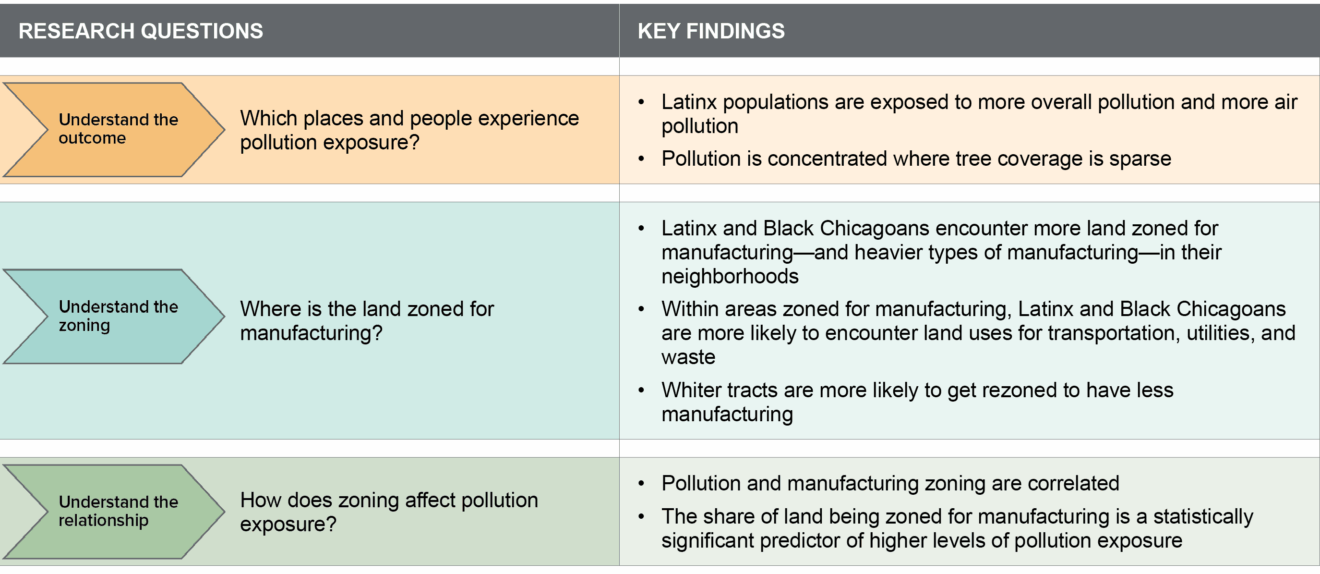
This analysis used two different measures of pollution exposure: cumulative pollution exposure and air pollution (PM2.5). It also analyzed tree coverage.
Limited Pollution Exposure: Research Questions & Key Findings
Read more
- Blog Series: Improving Zoning Together: Pollution Exposure Outcome (Part 1 of 2)
- Blog Series: Improving Zoning Together: Pollution Exposure Outcome (Part 2 of 2)
Accessible Public Transit Hubs

Resources
Accessible Public Transit Hubs: Research Questions & Key Findings

Productive Land Use

Resources
Productive Land Use: Research Questions & Key Findings
Available Groceries and Healthcare

Resources
Available Groceries and Healthcare: Research Questions & Key Findings
Read More
Mitigation and Adaptation to Climate Change

Resources
Mitigation and Adaptation to Climate Change: Research Questions & Key Findings