Bus Rapid Transit
Chicago’s new route to opportunity
Issue
Long commutes, poor connections for many Chicagoans
Chicago’s rapid transit network was built with the assumption that most travelers needed to go downtown, leading to our hub-and-spoke system of rail lines that converge on the Loop. Cross-town trips—those that do not need to pass through downtown—require slow bus trips.
More Chicago Transit Authority (CTA) riders use buses than trains. There are 170 million CTA bus trips each year system‑wide—including roughly 6 million on the north–south Western Avenue corridor.
We must reduce the delays and unreliable service that bus riders experience in mixed traffic. BRT is a proven and effective solution.
Solutions
Connected network of rapid, reliable transit service
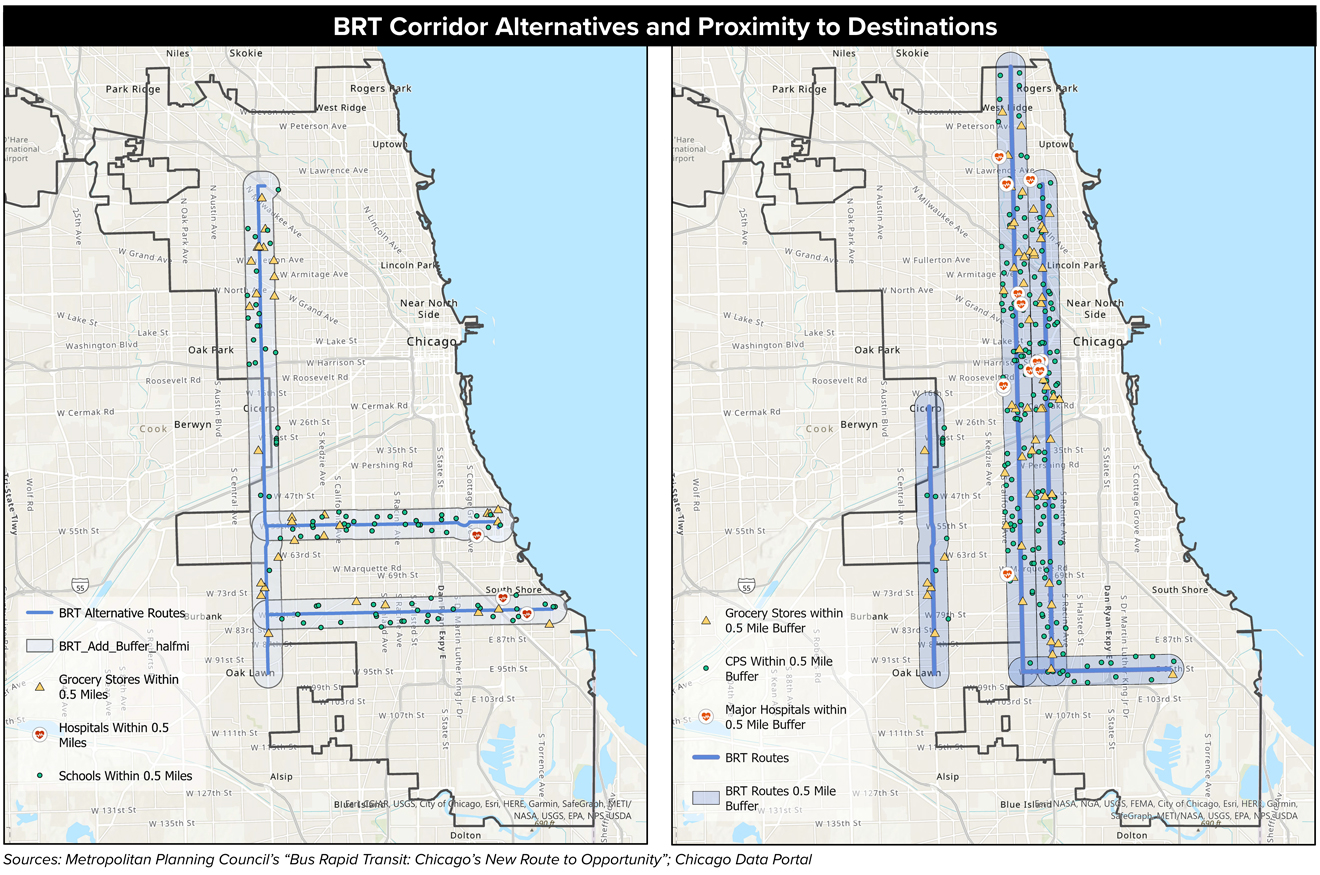
Bus Rapid Transit (BRT) is a standard of transit service that provides rail-like speed and convenience at a fraction of the cost of installing rail. In the report, Bus Rapid Transit: Chicago’s New Route to Opportunity, Metropolitan Planning Council (MPC) laid the groundwork for a 10-route BRT network in Chicago that would provide more equitable transit service to help people access jobs, shops, schools, hospitals and other destinations across the city.
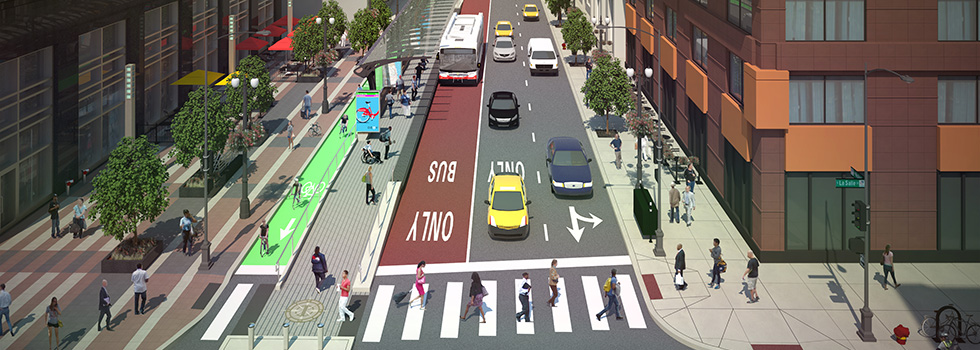
Gold standard BRT includes four key elements that make it truly a rapid transit experience: dedicated bus lanes, pay-before-you-board stations, signal prioritization and at-grade boarding. After piloting some elements of BRT on Jeffery Boulevard; the City of Chicago built Loop Link in 2015.
Benefits
Better transportation options, new development opportunities
- BRT in the Central Loop provided via Loop Link, which is used by multiple bus routes, has improved connectivity within the region’s primary business district, linking people to jobs and multiple modes of public transportation.
- BRT will provide better connectivity to neighborhoods that currently lack fast and reliable bus service, especially on the West Side of the city.
- BRT on Western Avenue will enhance essential north-south connections while linking to existing CTA and Metra rail stations.
- BRT’s enhanced service and substantial, neighborhood-defining stations will generate high-potential opportunities for community and economic development along the Western corridor.
Metropolitan Planning Council, (MPC) continues to advocate for BRT across the region. An effective transportation network makes connections—between people and the places they want and need to go, between businesses and customers, and between neighborhoods and the broader city and region. We encourage our partners to pursue transformative projects to substantially improve bus speeds and service rather than small, limited-impact treatments.
MPC is part of the Transportation Equity Network (TEN), a coalition of community groups, equitable transportation advocates, civic organizations, and other stakeholders in Chicago and suburban Cook County. TEN works with decision-makers to embed racial equity and mobility justice into transportation policy through community-driven decisions and investments.
TEN has advocated for BRT and guided the CTA and the Chicago Department of Transportation (CDOT) on the selection of bus priority corridors for a feasibility study, based on community needs, key destinations, and roadway dimensions that can accommodate the transformative improvements that BRT requires. This work builds on the corridors identified in the Better Streets for Buses plan produced by CTA and CDOT.
To inform selection of the corridors, MPC developed a series of maps highlighting the importance of these routes based on key destinations and on the existence of available roadway dimensions suitable for a gold standard BRT. These corridors were grounded in MPC’s report Bus Rapid Transit: Chicago’s New Route to Opportunity.
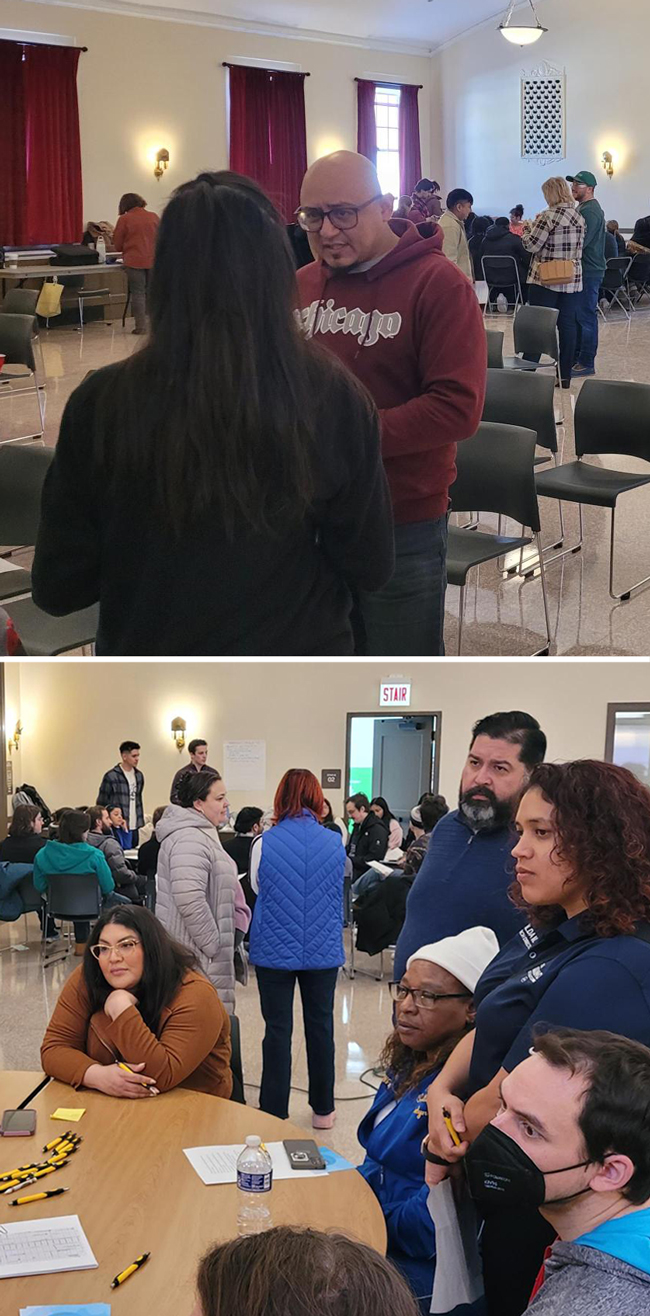
In 2024 and 2025, the coalition focused on building excitement and educating communities along the corridors selected for the feasibility study: Western, Pulaski, Fullerton, Cottage Grove, and 65th/Garfield. Community-led town halls highlighted the benefits of bus-priority infrastructure. TEN also organized a site visit to Madison, Wisconsin, to give community-based organizations an opportunity to experience a gold standard bus rapid transit system in action.
In 2025, community engagement led by local community-based organizations resulted in the development of a Bus Priority Vision document that outlines important themes and principles to guide the process led by CTA and CDOT.
This document summarizes the priorities identified during the community meetings and provides key recommendations, including:
- Implementing the most effective bus improvements available—such as dedicated lanes where space allows, and transit signal priority and queue jumps along all corridors.
- Coordinating with the Chicago Department of Planning and Development to establish anti-displacement policies along the corridors.
- Encouraging CTA to prioritize bus electrification along these routes.
- Ensuring CDOT keeps ADA accessibility at the center of future corridor design.
MPC is collaborating on recommendations from the feasibility study and will continue to advise the effort and promote alignment with TEN’s Bus Vision to support transformative, long‑term improvements to bus service. The feasibility study is anticipated to be complete by the end of 2026.