
What Are the Stakes For Developers in Transit Funding and Reform?

By: Hugo Coronado

By: Audrey Wennink
October 14, 2025 / Blogs
October 14, 2025 / Blogs
EVENT RECAP:
Transit & Real Estate Talks: Session 1
The Chicago region’s transportation system is at a crossroads. With urgent calls for reform and a looming fiscal cliff threatening service cuts of up to 40%, decisions made in Springfield this fall will shape not only the future of transit, but also real the estate market, community development, and long-term economic competitiveness of the region.
Over the past two years, advocates and public-sector leaders have been vocal about the need for a funding solution followed by meaningful reform. Now, the real estate sector is joining that call. Across sectors, the message is the same: transit brings stability and opportunity. The question is not whether to save transit, but how to fund it sustainably and transform it into a catalyst for regional growth.
To explore what’s at stake and what’s possible, on October 9, 2025, MPC convened a virtual discussion with leaders from across sectors—developers, planners, advocates, and academics—to discuss the economic implications of Illinois’ transit funding crisis and the opportunities that reform could unlock.
Panelists included:
- Paula Worthington, Senior Policy Advisor, Civic Federation, and Lecturer at the University of Chicago Harris School of Public Policy
- Quintin Primo III, Founder and Executive Chairman, Capri Investment Group
- Wyllys Mann, Senior Vice President, MVAH Partners LLC
- Drew Mitchell, Partner and Senior Vice President of Development, Holladay Properties
- Juan Sebastian Arias, Executive Director, Elevated Chicago
Moderated by Audrey Wennink, MPC Senior Director
Understanding the fiscal cliff and the opportunity ahead
Moderator Audrey Wennink opened the discussion with a reminder of the extent of the region’s transit assets: Metra operates 11 commuter rail lines, CTA runs 8 rail lines and 127 bus routes, and Pace serves 274 municipalities and provides paratransit throughout the region. Collectively, these systems connect people to opportunities and anchor the region’s economy.
However, without new funding, the region faces a fiscal cliff that could result in drastic service reductions starting in 2026. Legislation presented in the last session, HB3438/SB2111 offers a path forward with:
- A new stronger regional transit agency (Northern Illinois Transit Authority) empowered to plan, set policy, and coordinate across systems, while CTA, Metra, and Pace remain operators.
- An additional $1.5 billion in operational funding to enhance service frequency and reliability.
- Modernized policies to support transit-oriented development (TOD).
Wennink emphasized that development near transit is critical for increasing ridership and advancing climate goals. “People can’t ride transit if they can’t live near it,” she said, noting that reducing vehicle miles traveled is essential to addressing climate change as was documented in the Metropolitan Mayors Caucus Climate Action Plan.
Demographic trends reinforce this: Millennials and Gen Zers are more likely than any previous generation to prefer living near transit, and people of all ages seek walkable, connected communities.
The economics of transit investment
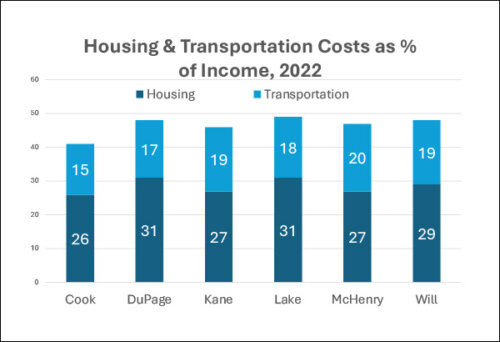
From an academic perspective, Paula Worthington underscored the evidence behind the economic value of transit. Research consistently shows that robust transit systems increase accessibility, land value, and job access while lowering transportation costs.
“When people make choices about where to live, they think not only about the cost of housing, but also about the cost of transportation,” Worthington noted that Cook County, where transit access is greatest, has among the lowest combined housing and transportation costs in the region. She warned that underinvestment would increase both economic costs and congestion, limiting access to education, work, and social opportunities.
Transit as a foundation for real estate opportunities

Quintin Primo III illustrated how transit drives redevelopment using a high-profile example: the James R. Thompson Center. Google’s decision to acquire and rehabilitate this iconic downtown building connected to six of the eight CTA rail lines, was driven by its unique transit accessibility.
“Probably the most important reason Google pursued this site was its connectivity,” Primo explained. “Six CTA lines converge here, moving nearly 9,000 people a day and over two million annually.” Google is also financing station upgrades to enhance transit accessibility, demonstrating how private investment and public infrastructure can align to revitalize the Loop.
In the suburbs, Metra stations are magnets for transit-oriented development (TOD). Drew Mitchell noted that since 2018, Holladay Properties has been building mixed-use projects near suburban stations to meet growing demand for walkable, connected communities.
“Three-quarters of the region’s population lives in the suburbs,” Mitchell said. “Having the ability to choose transit improves quality of life and drives economic growth.” He cautioned that losing transit funding would reverse decades of progress: “It would be absolutely tragic if our transit system lost funding…if the same thing that opened up the Chicago suburbs to population growth and business and entertainment is the same thing that took it down. It scares me.”
He noted that Baby Boomers are making up one of the largest demographics converging on the downtown nucleuses. “They are after walkability, the train to the Lyric Opera.”
Mitchell says he prefers his developments “to be right at the train.” Quality investment begets quality investment. If you do a high-quality investment at the corner of Main and Main in suburban Chicago, it will have dramatic and positive benefit on the stuff around it.” New housing developments in suburban downtowns have a noticeable impact on commercial vacancies downtown, according to Mitchell. In the case of a recent project in Westmont, the number of commercial vacancies has declined nearby. “People are spending money. It’s creating a positive feedback loop. The downtown is much more active.”
Transit as a platform for collaboration and equity
Wyllys Mann discussed his firm’s work on a transformative project in Harvey, the city’s first new construction permitted in three decades. Supported by Cook County, the RTA, and local partners, the affordable housing development was made possible through previous TOD planning and investment in the Harvey Transportation Center. “It’s not just the trains and buses that make a place desirable,” Mann said. “It’s the investment in planning from agencies that makes developments possible.”
Juan Sebastian Arias expanded on the importance of public investment and planning from the advocacy perspective. Through Elevated Chicago, he emphasized how equitable transit-oriented development (ETOD) policies are creating inclusive growth. The Lucy Gonzalez Parsons Apartments in Logan Square and 43 Green in Bronzeville are both near transit and most of their apartments are affordable. Both leased up within months of opening, demonstrating strong demand for affordable housing near transit.
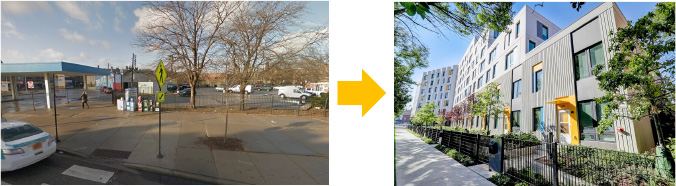
“ETOD is more than just affordable housing,” Arias said. “When we reduce parking mandates and invest in public infrastructure, we also make room for small businesses and community amenities to thrive.”
The path forward: risks and possibilities
Panelists agreed that the stakes are high.
If transit funding falters, Mann warned, “It will kill projects…I don’t think it’s just residential. I think it’s true for commercial—that commuter traffic drives shopping and drives patterns of consumer spending.” Primo added that service cuts would “stunt the growth of the return to office trends,” where downtown occupancy is nearing 70% of pre-pandemic levels, and will harm downtown economic recovery.
In contrast, expanded investment could generate a powerful “positive feedback loop,” said Mitchell. “What direction are we going? If you start to reduce transit, people start losing options…Congestion is the 2nd worst in the country and 3rd worst in the world…what happens when we get rid of more trains? It gets worse. It’s really frightening.” He noted that not only do we need to address the funding gap but we need more transit to serve current needs. “Right now, you can’t go see a Cubs game from the suburbs at 1 pm” via transit.
Arias noted that “There is a $13 return in economic activity for transit investments. People want to live near transit currently. If people knew they could rely on it, more people would ride transit, they would be saving money by not owning cars. There are clear benefits for overall family and household quality of life and wellbeing.”
We need the improvements to service that the transit reforms promise: “There is significant upside for ridership if we have transit that is secure, on time, often, clean etc.” said Primo.
Mann noted a benefit of increased transit ridership is reducing congestion and helping freight move better. “Traffic also slows down commerce. Goods are sitting on the road not getting where they are going.”
More riders means a more financially stable system: “If you can attract more riders, you attract more operating revenues into the system which reduces pressure on other sources of funding to keep buses and trains running. The positive and virtuous feedback loop delivers benefits on the economic, environmental and fiscal front,” said Worthington.
Unlocking more development through smarter policies
Reducing parking requirements near transit emerged as a practical and high-impact reform that makes development more feasible and affordable. Mitchell explained that structured parking can cost $50,000 to $60,000 per space, an expense that drives up project costs and rents. “Parking is subsidized by the balance of the real estate project.”
Primo added that downtown, “cost per stall is up to $100,000; eliminating 100 spaces can save $10 million. Parking is one area that is not needed in an urban, active, vibrant scenario and can produce much economic benefit that can be passed on to consumers.”
When people can live walking distance from suburban transit, there is less demand for parking. “A lot of times the railroad has land right at the train. There may be 150-200 parking spaces and only 1/3 of spaces are used. Doesn’t that want to be housing and business and retail at the center of the nucleus?” asked Mitchell.
Audience questions highlighted further opportunities, including the potential for transit agencies to develop land they already own near stations. Mitchell and Mann agreed this could unlock new public-private partnerships if agencies proactively inventory their land and streamline collaboration with developers.
A shared vision
The message was clear: sustained transit investment is essential to the region’s economic health, housing affordability, and climate goals. A wide range of stakeholders in the region will benefit from a more robust, connected, resilient, and equitable transit system.