
Illinois Passes the Northern Illinois Transit Authority Act

Illinois received a Halloween treat to remember this year as The Northern Illinois Transit Authority Act (SB2111) passed the Illinois General Assembly in the early hours of October 31, 2025, and Governor Pritzker made clear he will sign it into law. This is a major milestone in Illinois—not just Chicago–transit history as the legislation (effective June 1, 2026) will create a new regional transit agency, the Northern Illinois Transit Authority (NITA), to replace the Regional Transportation Authority (RTA) and significantly reform the governance of CTA, Pace, and Metra. The Act also defines new funding sources that will not only sustain transit through its current funding gap but also provide additional resources to support more frequent and reliable transit service throughout Northeastern Illinois and the entire state. A summary of the legislation is available here.
We are hopeful that this reform process will continue to be centered on the transit riders, both current and future, as well as the entire range of stakeholders who this effort benefits: transit workers, large employers, families, and all of us who live and work in this region. MPC is so pleased that Illinois kept our trains on the tracks and buses on the road and that those routes now lead into the future.
Governance
NITA will be empowered with significant regional responsibilities to provide integrated, rider-centered service in the six-county Chicago region. The new agency will oversee regional transit planning, fare setting, budgeting, capital programming, marketing, and major project delivery. NITA’s board will be comprised of 20 members: 5 each from Chicago Mayor, Cook County President, Governor; and one each from DuPage, Kane, Lake, McHenry, and Will Counties. Approval of NITA board actions will require an affirmative vote from 12 members including at least two from each of the four appointing authorities or 15 out of 20 members, regardless of jurisdiction.
An innovative feature of the new board structure is that the majority of CTA, Pace and Metra board members will be derived from the board of NITA — 4 of 7 CTA, 6 of 11 Metra and 7 of 11 Pace board members. This “overlap” is intended to boost regional information sharing and integration between NITA and the service boards that will deliver transit service day-to-day.
Transit Supportive Development
To boost the accessibility of areas served by transit, improve pedestrian safety, and reduce housing costs, the bill prohibits local jurisdictions from establishing minimum parking requirements for developments within one-half mile of transit rail stations and bus hubs or one-eighth mile of corridors with high transit frequency (combined bus route frequency of 15 minutes or less during peak periods). This means developers will be able to calibrate the level of parking needed for each development based on context and market needs instead of arbitrary zoning rules. This policy is intended to avoid overbuilding parking in the very areas that are intended to offer transit access and walkability.
The legislation authorizes NITA to do transit-supportive commercial and residential development, also known as joint development, directly or in partnership with other public and private entities. Such developments are designed to facilitate access to and use of public transit by putting housing, jobs, and amenities close to transit. The legislation is explicit that NITA’s transit-supportive developments must comply with local land use requirements.
Roadway Policies to Support Transit
The legislation establishes a Transit Integration Policy Development Committee at the Illinois Department of Transportation to better integrate transit policy, planning, and design into Department decisions and highway planning and design. A new Transit Coordination Oversight Officer position will be established to oversee implementation of policies recommended by the Committee. The legislation also denotes that IDOT and the Illinois State Toll Highway Authority must collaborate with NITA and other transit providers on the implementation of bus rapid transit. NITA is also enabled to cooperate with local governments on enforcement of local laws such prohibitions on vehicles blocking bus lanes and bus stops and, if necessary, to set up its own administrative enforcement system to enforce laws protecting transit operations and transit user safety
Funding
A core funding source for transit operations moving forward will be shifting the sales tax on motor fuels from the Road Fund to the Public Transportation Fund (85%) supporting Northeastern Illinois transit operations and the Downstate Public Transportation Fund (15%). The sales tax on motor fuel is estimated to generate about $860M per year.
The legislation calls for raising the existing Regional Transportation Authority sales tax by 0.25 percentage points, to 1% in Lake, McHenry, Kane, DuPage and Will counties and 1.25% in Cook County. The tax hike is estimated to generate $478 million annually.
Interest on the Road Fund estimated at $200 million per year will be directed to transit capital investments moving forward, with 90% going to NITA and 10% directed downstate.
While not funding transit, the legislation raises tolls for passenger vehicles on Northern Illinois’ toll roads by 45 cents per toll; commercial vehicles will see a 30 percent toll increase. Both are indexed to inflation. These toll increases are estimated to raise up to $1 billion annually to support a new capital program for the Illinois Tollway.
Transition
The NITA Act calls for the new NITA board and service boards to be seated by September1, 2026. Illinois DOT will procure a transition consultant by Sept 1, 2026. A Transition Working Group comprised of 15 members will be seated by October 1, 2026 and submit a Transition Plan and report to the Illinois General Assembly by July 1, 2027.
A Multiyear Journey
MPC has high hopes for NITA and the future of transit in Illinois. The process to get here has been a multiyear journey involving hundreds of partners. In 2022, MPC advocated for the ILGA to require a study of regional transit funding and governance needs, which resulted in Illinois Public Act 102-1028 (SB3848) being enacted in May 2022, tasking the Chicago Metropolitan Agency for Planning with developing legislative recommendations for the region’s transit system. In December of 2023, CMAP released its Plan of Action for Regional Transit report defining the challenges and possibilities for transit if we had the courage to enact broad reforms and funding solutions. Advocates then joined together under the umbrella of the Illinois Clean Jobs Coalition comprised of hundreds of organizations statewide to move the recommendations into action. MPC had a lead role within the coalition, convening weekly transit working group meetings over a two-year period, contributing to drafting the legislation, exploring funding options, developing numerous communications materials, conducting legislative education and participating in legislative negotiations during the Spring of 2025 and during the Fall veto session. A sample of MPC’s work can be found on our transit reform web page.
None of this would have been possible without the passionate and knowledgeable legislative champions who worked on this issue day and night for years: Senator Ram Villivalam (D-8), Representative Eva-Dina Delgado (D-3), and Representative Kam Buckner (D-26). Illinois showed that having a comprehensive process including robust analysis and significant engagement resulted in our state developing a solution that could gain legislative support, unlike in some other states.
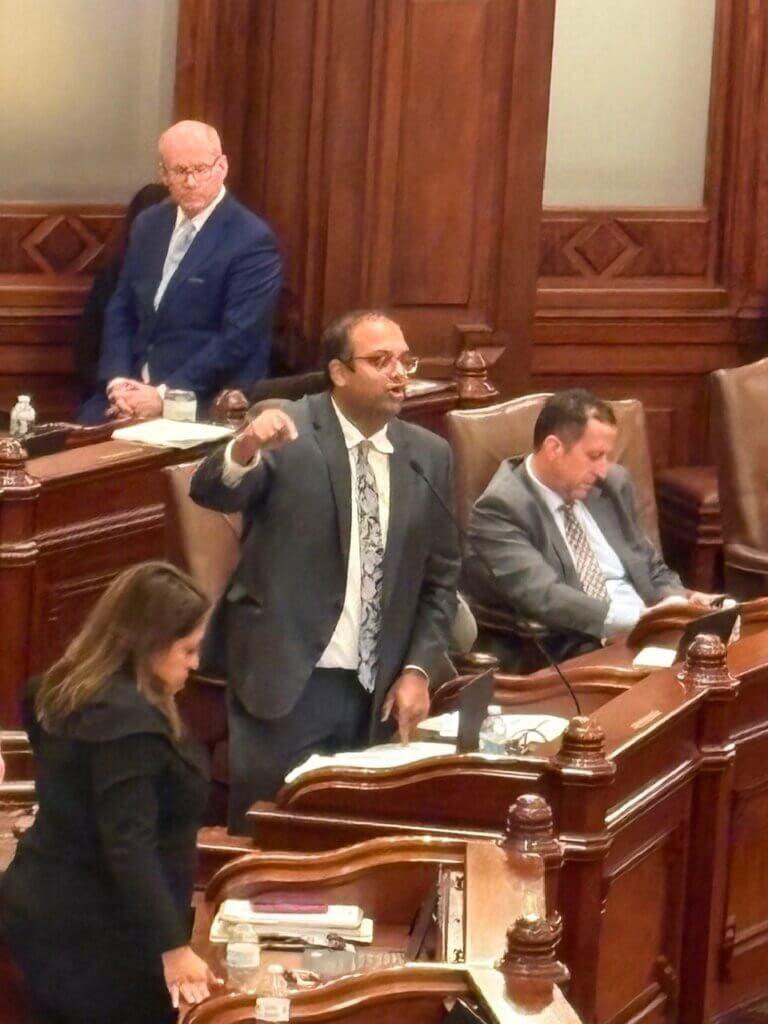
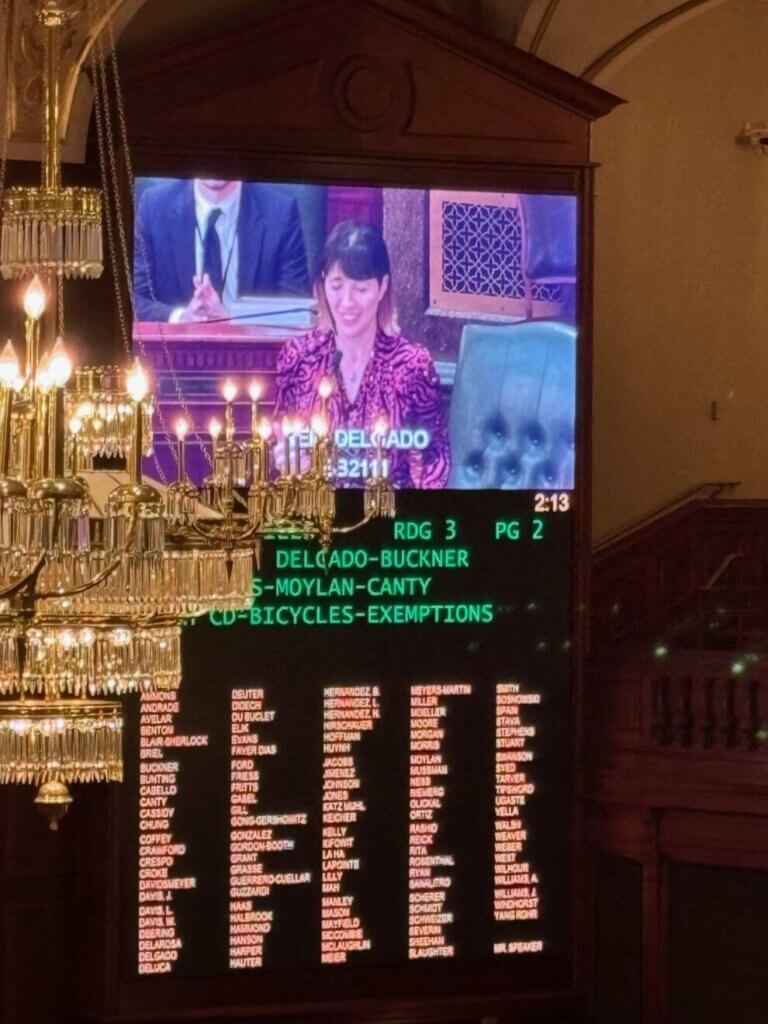
ABOVE (L-R): Senator Ram Villivalam (D-8) introduces the legislation; Vote screen shows Representative Eva-Dina Delgado (D-26)
Conclusion
We have defined and committed to a path forward for the future of transit in Illinois. But equally challenging work lies ahead. Next steps include: identifying capable community leaders to serve on the NITA board and service boards, attracting new agency leadership from both a global talent pool and by tapping the expertise within our own agencies, and developing an actionable transition plan.
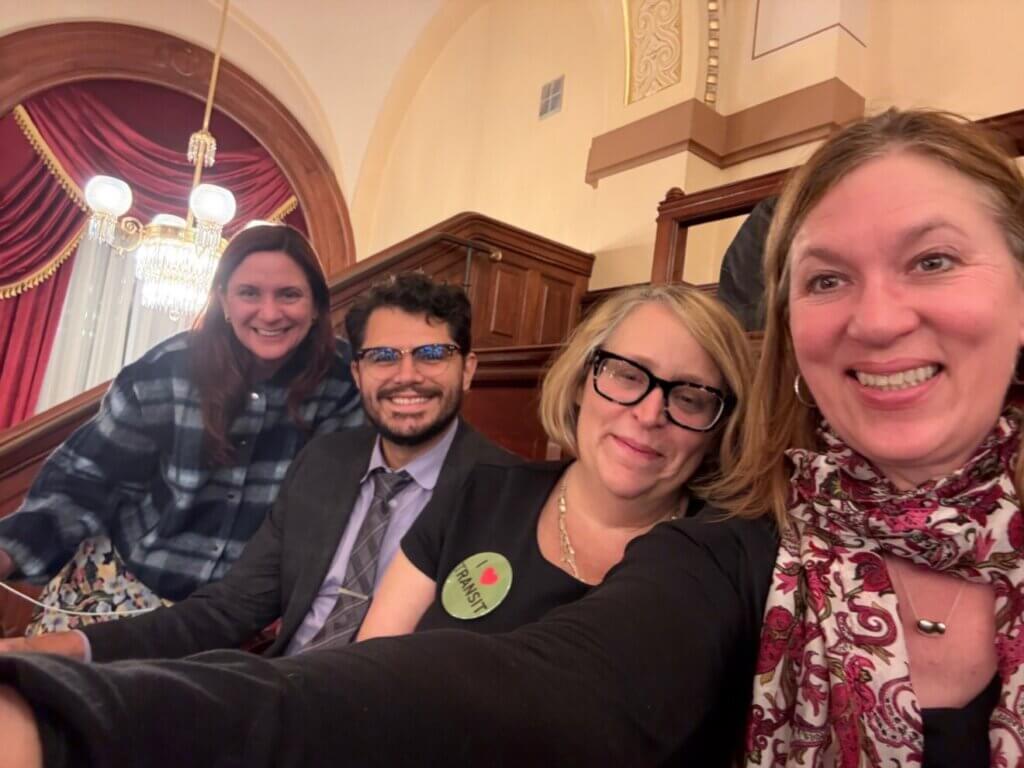
ABOVE: Coalition members await the vote at the Illinois Capitol