
Green Stormwater Infrastructure: Opportunities in Transportation

By: Hugo Coronado

September 4, 2025 / Blogs
September 4, 2025 / Blogs
This is the second of two blogs that show how Green Stormwater Infrastructure (GSI) can provide a means for creating more resilient infrastructure and healthier communities. The article supports the work Metropolitan Planning Council (MPC) is doing as part of the Right Infrastructure, Right Place (RIRP) project, an initiative working toward policy and systems change to address significant climate challenges in the Chicago region.
Greening the right-of-way: why GSI and transportation should be linked together.
 Streets are more than just conduits for moving people, goods, services—they are some of the largest public assets cities own, accounting for roughly a third of urban land. Every time a street is rebuilt, we have a chance to shape how we live with water, improve neighborhood quality of life, and build resilience to a changing climate.
Because right-of-way (ROW) construction projects touch nearly every part of a city, they are a prime opportunity to build Green Stormwater Infrastructure (GSI) at scale. Adding features like permeable pavers, rain gardens, stormwater tree planters, and bioswales into transportation infrastructure can reduce flooding, improve water quality, cool overheated neighborhoods, and create more welcoming public spaces. As climate impacts intensify, cities like Chicago should look at every infrastructure investment as an opportunity to make communities stronger and more resilient.
What other cities are doing
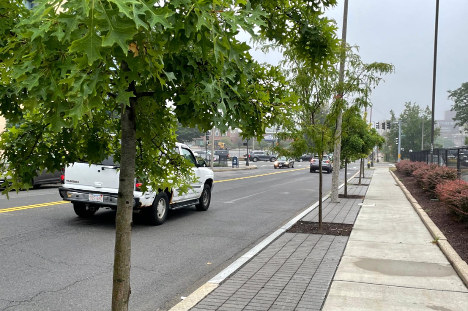
Green Stormwater Infrastructure in the public right-of-way isn’t a new idea. Cities across the country are expanding construction of green alleys, curb extensions with stormwater planters, and even bus shelters with green roofs. In the face of more frequent and intense rain events, these solutions are becoming standard practice. Cities that invest in green transportation infrastructure today are preparing for tomorrow’s climate reality.
Boston offers a strong example with the creation of its Office of Green Infrastructure, which coordinates with major capital projects in the right-of-way to identify opportunities for incorporating GSI. This effort is made possible by a dedicated funding stream from the city’s stormwater charge, which supports both the office’s operations and the maintenance of green infrastructure assets.
Chicago’s opportunity
Chicago has more than 4,000 miles of streets. Each year, the City of Chicago resurfaces and rebuilds miles of them—with each project presenting a fresh opportunity to do more than just patch pavement. The passage of the 2023 Complete Streets Ordinance requires the Chicago Department of Transportation (CDOT) to assess how all users are accommodated in street designs and consider the inclusion of Complete Streets features during any resurfacing or reconstruction.
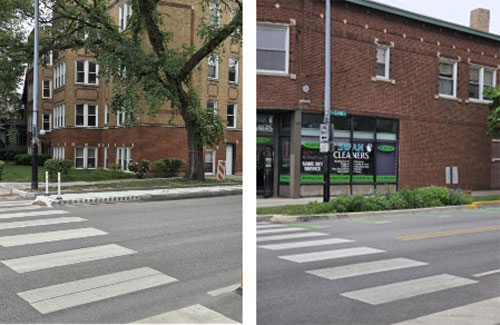
Complete Streets are designed to be safe and accessible for people walking, biking, riding transit, and driving. These projects often include bump-outs and curb extensions, ideal spots for integrating GSI. CDOT’s new Complete Streets Guidelines provide a roadmap for including these features. However, the guidelines can go even further by incorporating GSI as a key component of future street improvements.
David Powe, Assistant Commissioner at CDOT, said that the city has consistently been open to incorporating green infrastructure into projects. In fact, CDOT actively seeks partnerships with new developments to integrate green infrastructure into the public right-of-way whenever opportunities arise and there is funding available to ensure long-term maintenance. While this approach could potentially become part of the long-term guidance for Complete Streets, establishing a dedicated funding source for maintenance and streamlining coordination with the Office of Underground Coordination is essential to avoid delays in project implementation.
Still, one key challenge remains: maintenance. GSI can reduce construction costs when it offsets the need for gray infrastructure, but it only delivers benefits if maintained. Without a long-term maintenance plan and funding commitment, these assets can fall into disrepair. That’s why cities must establish clear responsibilities and sustainable funding mechanisms for GSI upkeep—just as they do for roads and sidewalks.
Efforts from multiple stakeholders involved in GSI began addressing this challenge through the Chicago Green Stormwater Infrastructure and Maintenance Working Group, which released a 2023 report outlining best practices and recommendations for sustainable GSI maintenance across the region. Among its key recommendations are the creation of dedicated funding streams, building a trained local workforce to manage GSI, and fostering coordination between city agencies and community partners to ensure these assets are maintained equitably.
The path forward
To make our cities more resilient to extreme weather, green infrastructure should be treated as a standard part of how we build and rebuild streets. CDOT’s guidelines provide a strong foundation, but we can go further by:
- Embedding GSI at every stage of street planning and design.
- Leveraging incentives for capital projects, following the example of MWRD’s Green Infrastructure Partnership Program.
- Establishing a dedicated revenue stream to support long-term maintenance.
- Building maintenance partnerships among city agencies, private developers, and community organizations.
- Sharing success stories from across the region to strengthen political will and public support.
While the benefits of GSI integration extend to every community, it’s important to prioritize neighborhoods most affected by climate change. This means considering long-term climate forecasts, existing land uses, landscape conditions, and sewer system capacity when making investment decisions. We already have resources that identify areas most susceptible to flooding such as the Chicago Metropolitan Agency for Planning’s Flood Susceptibility Index.
Our streets are on the frontlines of climate change where flooding, heat, and aging infrastructure converge in our communities. They are also some of the largest public assets cities own—and every resurfacing, reconstruction, or new bike lane project can help transform roads into greener, more resilient public spaces that improve the quality of life for everyone.
At the time of this writing, David Powe no longer oversees the public way policy section; Assistant Commissioner Dave Smith now leads that team, along with complete streets and traffic review.